
Helen and Eve indicated that their family branch came from Czestochowa, Poland, which is 400 km (250 miles) from Bielsk. They then pulled out a 1947 Yizkor book from Czestochowa and showed me a three-page Yiddish section beginning on page 49 describing Elkon's family. I asked Eve to skim the text to find any section dealing with Elkon's grandfather. Sure enough, there was a paragraph on his "zadie", and it stated the zadie came from Bielsk in Grodno Gubernia.
With an obvious geographic connection, we looked for other clues of relationship. The book said that zadie Tzvi Hirsh lived to 106 (later determined to be exaggerated), which certainly was consistent with the longevity of other known relatives. Many of the names in the Tzvi Hirsh branch (i.e., Yosef, Yitzhak, Shmuel, Hirsh) also appeared in Eli Yankel's family. Finally, I found Elkon's L.A. address in Clara Sokol's (Shifra Leah branch) personal telephone book.
With all this evidence and new data located at the Grodno Archives in 2013, we believe that Tzvi Hirsh was a second cousin to Eli Yankel.
-- Mark Gordon
Tzvi Hirsh Chrabolowski was born in 1823. His father was Elkon (born in 1787) who lived in Ryboly. Tzvi Hirsh later moved to Lapy. He worked in the fish business and owned an inn (or tavern). His grandson Louis told his children that Tzvi Hirsh was a rabbi, with the inn and fish business done on the side with his family's help; granddaughter Annie Iglarsh told her children that Tzvi Hirsh was known as the town sage. Coming to him for consultation, they asked him questions about the dietary laws and other aspects of Jewish observance. Tzvi Hirsh married Chana Rivka (born in 1828) and had four children: three sons, Yosef Yitzhak, Elkonah and Shmuel; and a daughter, Malka (Malke).
Elkon Chrablow, Tzvi Hirsh's grandson and last of Yosef Yitzhak's children to emigrate to the United States, writes in his family remembrance article that it was later forbidden for Jews to run an inn, and the town fell into poverty. Searching for work, Tzvi Hirsh, Yosef Yitzhak and Yosef's son Elkon -- three generations -- traveled to Shmuel's home and blacksmith shop in Lapy. Grandfather Tzvi Hirsh and grandson Elkon slept together in the attic. Elkon described his grandfather: "He was in his seventies [then], and he died when he was 106 years old. His sight was excellent and his hands didn't shake....he had beautiful handwriting which he kept into his old age." Tzvi Hirsh died about 1913. A picture of him with his eldest son, Yosef Yitzhak, is shown in fig. 9.
Elkonah (Yudel)
Tzvi Hirsh's son Elkonah later took another name, Yudel Kaplonsky, when he was of draft age in order to avoid military service. A very religious man who wanted to maintain the kosher dietary laws, Elkonah took the name of someone his approximate age who had died, and in that way avoided military service for the czar. Yudel was a blacksmith and also farmed on the side after buying some land through a Gentile since land purchase was forbidden to Jews at that time. He was the only Jew in the farm village Wnory Stare (or Stare Wnory). Yudel married Pesche Leah Katowits, and they had 14 children.
Frances Lepkowsky, Yudel's daughter born in 1898, recalls that as she became older, the Jewish community was constantly in danger and she "would go to bed and wonder if something would happen. While I was there, I died every night." When she was around 16 years old and her sister Chana was 18, a group of soldiers came to the home around midnight while parents Yudel and Pesche were away in the city for Rosh Hashanah. Chana, who was not married, told the soldiers that she was a young widow with two small children who were frightened because of them. The soldiers said they would come back later; Frances and her sister went outside and hid in the bushes and wild grass. The pogroms intensified in the cities. Because of the persecution, Frances and some of her siblings emigrated to the U.S. and later settled in New York, California and Brazil.
Three of Yudel and Pesche's children and their families were killed in the Holocaust; seven survivors of the community emigrated to the U.S. and told Frances of their deaths. Pesche, whom Frances remembers as being a clever, hard-working woman, was killed in the Holocaust at the age of 88; Yudel had died earlier in 1934. Frances said, "In the Holocaust, the lucky ones were the dead ones, the ones who died before it happened."
Shmuel & Malka
Blacksmith Shmuel and his wife Chana, who lived in Lapy, had no children, and Frances remembers him as being more talkative than her quiet father. Tzvi Hirsh's daughter Malka (Malke) had four children; one was killed in a pogrom in Bialystok in 1905, and Malka's other children emigrated and eventually settled in the New York and Los Angeles areas.
Yosef Yitzhak
Yosef Yitzhak (Yosel), who was born in 1851, is known to have lived in Andrzejewo (Lomza Gubernia) as well as Lapy and Czestochowa. He was a Hebrew teacher (melamed) and candle and cigarette maker who married Rebecca (Rivka) Axelrod, daughter of a candle-making family. Rebecca was born in 1858 in Zambrow; her birth register is shown in Appendices I and J. They married in June 1875 in Zambrow, and son Yankel (given name later changed to Joe) was born there two years later.
As Elkon Chrablow writes in the family article mentioned above, most of Yosef Yitzhak's children were born in Andrzejewo "and spent their 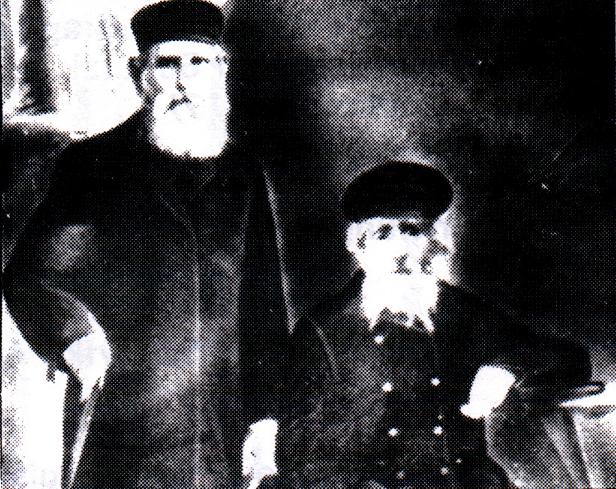 childhood years there and as soon as they grew up, they spread to all parts of the world like birds from a nest." Yosef
(Yussel) and Rebecca (Rivka) had nine children; two died very young and one daughter, Eve (Eva), died while in her
teens and was buried in Bialystok. The remaining children and their birthdates were Fannie (Slava Feigel), c.1882;
Annie (Chana), 1890; Elkon (Elkonah), 1885; (Solomon) Louis, 1895; and Sam (Shmuel), 1897.
childhood years there and as soon as they grew up, they spread to all parts of the world like birds from a nest." Yosef
(Yussel) and Rebecca (Rivka) had nine children; two died very young and one daughter, Eve (Eva), died while in her
teens and was buried in Bialystok. The remaining children and their birthdates were Fannie (Slava Feigel), c.1882;
Annie (Chana), 1890; Elkon (Elkonah), 1885; (Solomon) Louis, 1895; and Sam (Shmuel), 1897.
Rebelle Chrablow Mills, Louis' daughter, recalls her father telling her that because of the wide range of ages of Yosef Yitzhak's children, wife Rebecca attended her oldest son Yankel's wedding while pregnant. The family later moved to Zawiercie (Zavyerche) in southern Poland, where Yosef Yitzhak continued his occupation as a melamed. In the summer of 1905, they moved to nearby Czestochowa, where Yosef and Rebecca lived the rest of their lives. He died in 1923.
The children's pleasures were typical of that time. Elkon remembered playing in the fields, and Lou loved flying cloth kites. A friend of Yosef Yitzhak would come to the house with raisins and treats in his pockets, and the children would climb in his lap to vie for them. Lou recalled his first job at age five, working for a butcher to keep dogs away from meat on a cart.
All of Yosef Yitzhak's children who survived to adulthood emigrated to the U.S.; daughter Fannie was the first to arrive in 1908. Fannie's fiancé had traveled to America earlier, but she had not heard from him; she waited and waited. Finally, Fannie broke off the engagement and agreed to marry Max Berliner. The first fiancé's family, hearing of these new developments, wrote their son about Fannie's romance, and he rushed back to Poland. But Fannie, a striking and determined woman, married Max Berliner anyway, and the two emigrated to America, working and saving money so other Chrabolowskis could come over.
Joe came to America in 1910 from Ostrow Mazowiecka after traveling back and forth to Europe a few years earlier; Annie emigrated in 1908 and married Harry Iglarsh in Chicago. Fannie sent money for Sam's passage in 1913. Louis came to Chicago in 1912 via the Frankfurt from Bremen to Philadelphia, arriving on March 22, 1912. He married American-born Selma Jaffe in 1921. Elkon and his wife, Helen (Chaya) Tempelhof of Lodz, were the last to permanently settle in the U.S. in 1929; all except Elkon resided in Chicago. Elkon later lived in Los Angeles and Lou retired there as well, but the other siblings spent the rest of their lives in Chicago. By most accounts, the children of these immigrants use the words "quiet" and "unassuming" to describe their parents, but Fannie was a "go-getter" and Sam talked and laughed a great deal like Shmuel, the uncle he was named after.
A page of the 1920 census in which the brothers and sisters are listed paints a picture of a typical Eastern European Jewish immigrant experience. Sam (age 22) and Louis (age 25) live with their sister Fannie (age 32) and her husband Max Berliner at 3127 W. Douglas Boulevard, an apartment building in the heavily Jewish community on the West Side of Chicago; two units away, Annie (age 30) is settled with her family. Neighbors, many of them also immigrants, are listed as having such professions as printers, auto accessory salesmen, jewelers, clerks, smelters and stenographers.
Annie's husband, Harry, and brothers Sam and Lou worked as tailors at the time. (Sam later worked for a major insurance company and married Rose, a woman he met on his route.) The eldest son, Joe, worked in the clothing business as a presser. Elkon was a mirror cutter when he came to the U.S. He also wrote numerous Yiddish books and was active in the Freeland League, which brought 250,000 Jews out of Europe to Dutch Guiana before 1939.
Fannie's husband Max was a furrier, and he later brought Chrablow relatives into the business although they divorced in the early 1930s. Fannie later married Sam Schwartz and ran a restaurant on the South Side of Chicago. She was active in relief work for a children's home in Czestochowa after World War I.
Eldest son Joe took the last name of Rosenberg from his wife Molly (Michla). Elkon, Louis and Sam all later shortened their surname to Chrablow.
Joe Rosenberg’s son Max married divorcée Della Murray, grandmother of Hillary Clinton, in 1933. At his 1901 birth in Ostrow Mazowiecka, Max started out life as “Moshek Chrabolowski”.
Louis and Sam served in the U.S. Army in World War I; Louis was an airplane mechanic for the Lafayette Escadrille, the first U.S. air force. Once, after repairing a plane for ace flyer Eddie Rickenbacker, the aviator told Lou, "All right, you take it back up. I'm not flying it until I know that you really fixed it."
Elkon, who had not yet emigrated, was in the Russian Army. As a POW in Austria, Elkon's life was saved because he could read and write. Later Annie's three sons served in World War II, and Elkon wrote, "Fanny had the strength to bake cookies for everyone."
Elkon also wrote in the 1940s, "Who knows if anyone from the grandfather Tzvi Hirsh descendants is alive in Europe today -- but we do know....the family is growing and they have weddings, b'nai mitzvot and brit milah and the family gets together for good simchas and good food....the great-grandchildren of Tzvi Hirsh will not know Yiddish, but at the weddings and simchas, when they start dancing in the old ways, their past comes back to them and brings them together."
Most of the descendants of Tzvi Hirsh are Americanized and now serve in such occupations a judges, lawyers, professors, salesmen, field technicians for nuclear and fossil fuel power plants, airline pilots and many other professions, but what they have in common is a town sage who was the owner of an inn and ran a fish business.

